 Oluwadi
Investigating the Overlooked
Region
What
Who For
Analysis
Oluwadi
Investigating the Overlooked
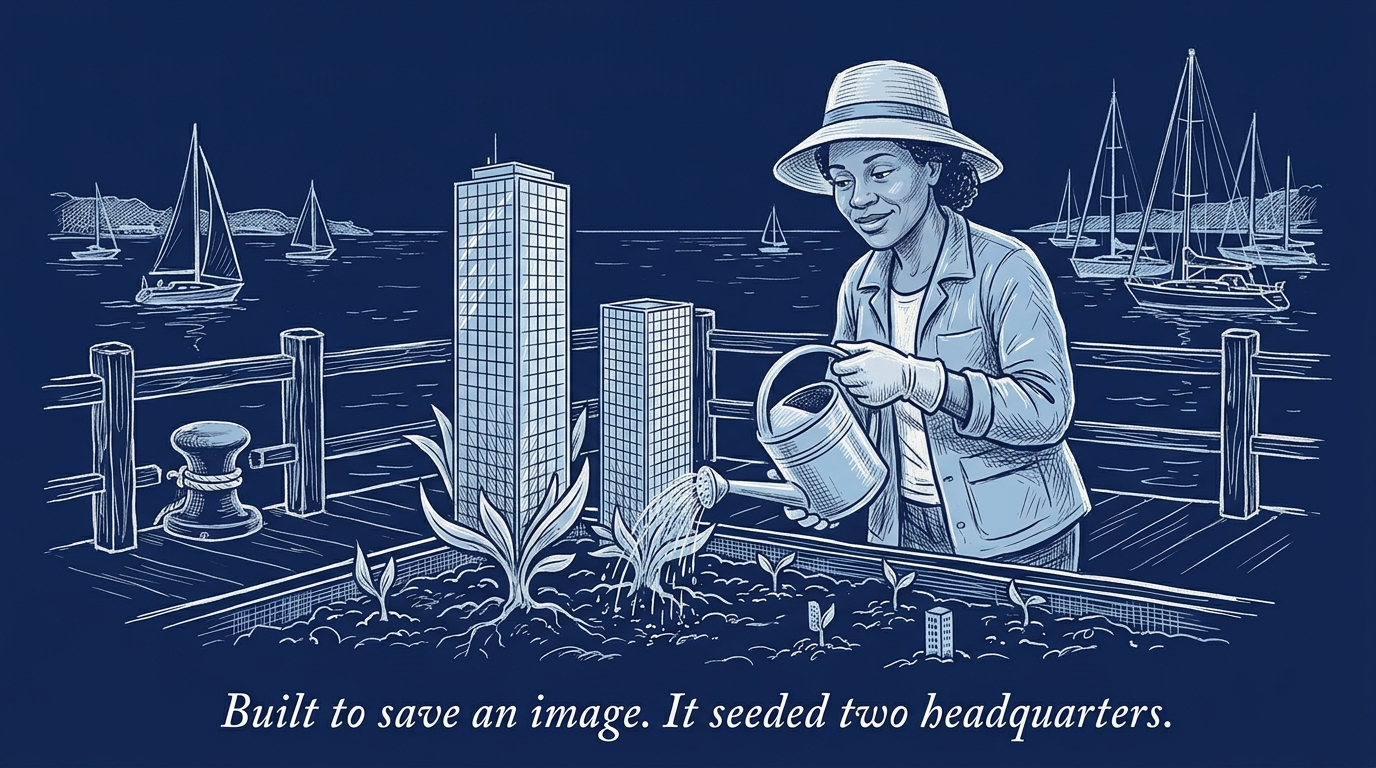
Start with why the waterfront needed saving in the first place, because the redevelopment was a real rescue, not a beautification project. Baltimore's Inner Harbor redevelopment effort began under Mayor Theodore McKeldin in the mid-1960s, as the city's industrial waterfront declined, and culminated on July 2, 1980, when Mayor William Donald Schaefer opened Harborplace on the reclaimed shoreline.[1] The American Institute of Architects later called it "one of the supreme achievements of large-scale urban design and development in U.S. history."[1] The result exceeded even ambitious expectations: seven million people visited in the first three months, and more people visited the Inner Harbor in its first year than visited Disney World.[1]
What the tourism story leaves out is what got built on the same reclaimed ground decades later, after the crowds had already proven the waterfront was worth building on. Under Armour was founded in 1996 by Kevin Plank, a special-teams captain on the University of Maryland football team, working out of his grandmother's rowhouse in Washington, D.C.[2] In 2002, to support its growth, the company moved its global headquarters into a converted soap factory at Tide Point -- directly on Baltimore's Inner Harbor, the same waterfront Harborplace had reclaimed twenty-two years earlier.[2] Under Armour has called that harbor home ever since.
A second global headquarters chose the same reclaimed waterfront for its 85th-anniversary building, not a coincidence of geography. T. Rowe Price, the asset management firm founded in Baltimore in 1937, broke ground on a new global headquarters at Harbor Point -- part of the same redeveloped Inner Harbor shoreline -- to mark the company's 85th anniversary.[3] A firm that has stayed headquartered in the same city for nearly ninety years chose to build its newest, most significant home on ground the city itself had to fight to reclaim from industrial decline two generations earlier.
The recovery this piece has been tracing was not uninterrupted, and leaving that out would flatten a real, painful part of the same story. On the night of March 28, 1984 -- four years after Harborplace opened -- fifteen Mayflower moving trucks pulled up to the Colts' training facility and left for Indianapolis under Indiana State Police escort, timed specifically to beat a Maryland General Assembly bill that would have let the city seize the team by eminent domain.[6] Baltimore had no NFL team for the next twelve years. It got one back in 1996 through the exact same kind of maneuver, on the other end this time: Browns owner Art Modell moved his franchise to Baltimore after his own stadium fight with Cleveland went nowhere, in a deal that let Cleveland keep the Browns' name and history for a future team while Modell's Baltimore franchise became the Ravens.[6] The same decade that built Camden Yards also handed Baltimore a football team by doing to another city what had been done to it twelve years earlier.
Twelve years after Harborplace, the same downtown revival produced a building that quietly rewrote how an entire sport designs its stadiums. Oriole Park at Camden Yards opened April 6, 1992, designed by HOK Sport, and became the first of the modern "retro-classic" ballparks -- built to feel like early-20th-century parks such as Ebbets Field and Fenway, in an urban, baseball-only setting rather than the suburban multipurpose "cookie-cutter" stadiums that had dominated for decades.[5] More than two-thirds of current major league ballparks have been built since, and nearly all of them borrowed directly from Camden Yards' template, starting with Cleveland's Jacobs Field in 1994 and Denver's Coors Field in 1995.[5] Baltimore did not just rebuild its own waterfront. It designed the building nearly every other American city's ballpark has copied since, twelve years into the same downtown revival that built Harborplace.
None of this is the Baltimore most people carry around as a mental image, and that gap is worth naming directly rather than working around. The city's national reputation runs heavily through crime statistics and television portrayals that never mention a $19.4 billion research institution, a $1.6 trillion asset manager, or a global apparel company, all real, all currently operating, two of them built on ground the city itself fought to reclaim. Both the reputation and the economic reality are real. Only one of them is what most people picture first. Under Armour's own story since this piece's own snapshot has gotten considerably more complicated -- a planned 4-million-square-foot campus, a 96% profit collapse, and a founder's return as CEO are the harder half of the same company's Baltimore story.