 Oluwadi
Investigating the Overlooked
Region
What
Who For
Analysis
Oluwadi
Investigating the Overlooked
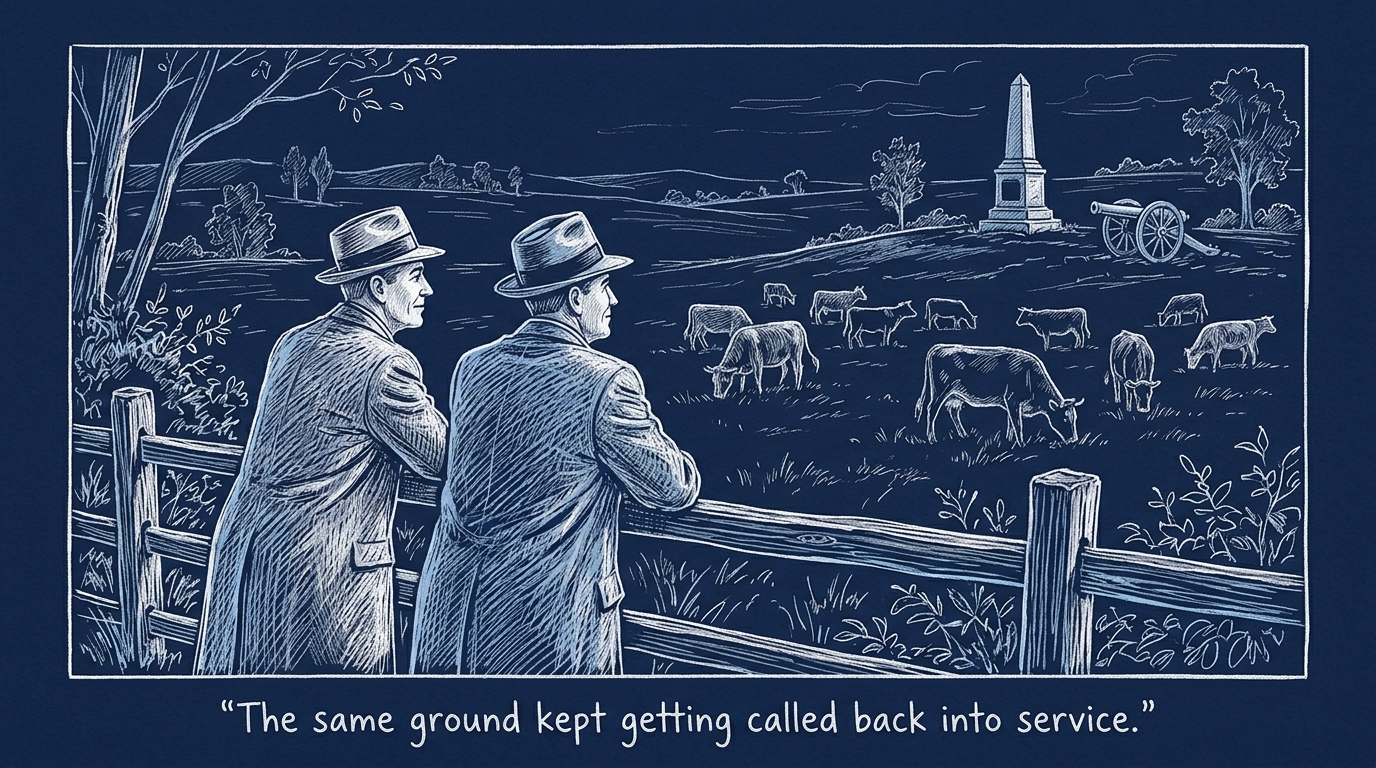
Start with how fast the preservation began, because the speed is the actual story. David McConaughy, a local Gettysburg attorney, began purchasing parcels of the battlefield in July 1863 -- the same month more than 51,000 casualties were suffered there over three days -- specifically to preserve the ground before it could be built over or forgotten.[1] The Gettysburg Battlefield Memorial Association was formally incorporated by the Pennsylvania legislature on April 30, 1864, while the war itself still had a full year left to run.[1] Most historic sites get remembered after the fact, once distance makes them feel worth saving. Gettysburg was never allowed the chance to be forgotten first.
Four months after the battle, the site got a second, completely different reason to matter -- one that had nothing to do with troop movements. On November 19, 1863, Abraham Lincoln spoke for roughly two minutes at the dedication of the new national cemetery holding more than 3,500 Union dead -- 272 words that redefined the war's purpose, tying it directly back to the Declaration of Independence's claim of human equality.[2] The Gettysburg Address is memorized in American classrooms independent of whether a student can name a single general who fought there. The speech, not the battle tactics, is why most Americans who have never studied the Civil War in any depth can still recite its opening line.
The site got reactivated a third time, in a century the battle never touched, for a reason that had nothing to do with the Civil War at all. Dwight Eisenhower bought a farm adjoining the battlefield in 1950 -- the only home he ever owned in his life -- and used it throughout his presidency for what aides called "barnyard diplomacy," walking world leaders through his prize cattle herd to ease them into serious conversation.[3] On September 29, 1959, at the height of the Cold War, Eisenhower brought Soviet premier Nikita Khrushchev to the farm, touring the grounds and going skeet shooting together in an attempt to thaw a real nuclear-era impasse.[3] A Civil War battlefield became, ninety-six years later, an actual Cold War negotiating table -- not a museum piece being toured, a working diplomatic tool.
The honest complication: the fourth reactivation this piece has been building toward may not be happening. Gettysburg drew 6.9 million visitors in 1970. That number has fallen every decade since -- roughly 1 million by 2009, 950,000 in 2018, 742,000 in 2023, 730,398 in 2025 -- an 86% decline from peak that is still moving in the same direction in the 2020s, not flattening out.[4] A national civic-literacy survey found only 40% of Americans could correctly identify a line from Lincoln's own address, and in one survey of college seniors, 28% thought Gettysburg was the battle that ended the American Revolution -- not a detail forgotten inside the right war, a confusion about which war it was.[5] The mechanism this piece describes -- meaning re-activated generation after generation -- is real and it happened three separate times. It is not guaranteed to keep happening, and the current data reads more like a pattern running out than a pattern still firing.
The outcome the battle actually decided didn't finish anything -- it started a process that took another half-century to become real at scale. Lincoln's own address called for "a new birth of freedom," and the Union's victory made emancipation legally permanent. It did not make it real for most of the people it freed: Reconstruction was violently rolled back within a decade, and Jim Crow, sharecropping, and debt peonage kept most Black Americans in the South in conditions barely removed from what the war had supposedly ended. The actual, mass exercise of the freedom Gettysburg helped secure didn't happen until World War I created Northern factory jobs and cut off European immigration at the same time -- triggering the Great Migration, roughly six million Black Americans moving from the rural South to Northern and Western cities between 1916 and 1970, reshaping Newark, Detroit, and Harlem into the same story told three times.[6] That piece is here. By 1970, the South held only half the country's Black population, down from the overwhelming majority before the migration began.[6] Gettysburg didn't complete that change. It is the place where the change was first declared -- fifty-three years before anything close to it actually started moving.
Formal federal protection came decades after the informal kind already existed. Congress established Gettysburg National Military Park by law in 1895, thirty-one years after McConaughy's private preservation association had already been buying and holding the land.[1] The government didn't create the site's significance -- it caught up to a significance the ground had already earned three separate times over, and formalized what a private attorney and a wartime president had already made real.