 Oluwadi
Investigating the Overlooked
Region
What
Who For
Analysis
Oluwadi
Investigating the Overlooked
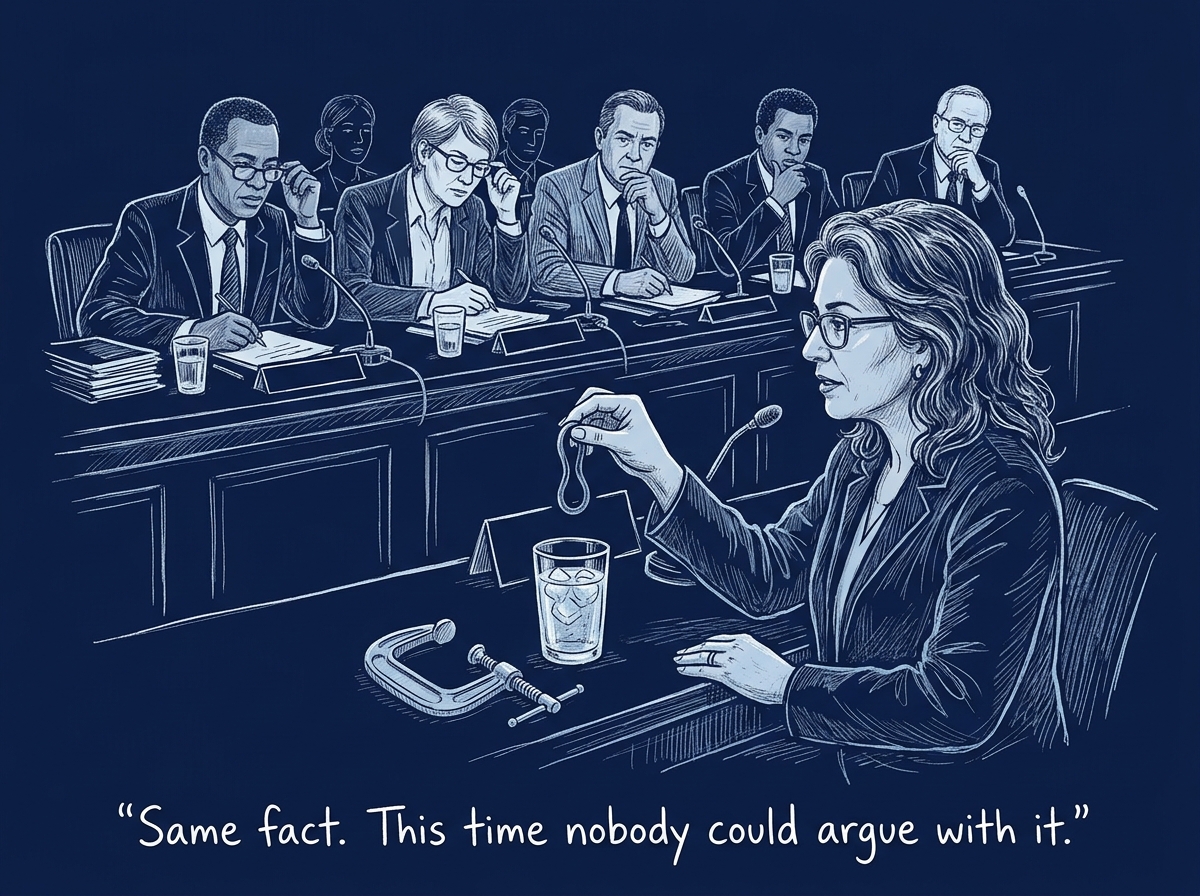
Start with the night before, because the facts were already there. On January 27, 1986, in a teleconference with NASA the night before Challenger's launch, Morton Thiokol engineer Roger Boisjoly and his colleagues argued for a delay: the rubber O-rings sealing the shuttle's solid rocket boosters lost resilience in cold temperatures, and the forecast for the next morning was well outside anything they'd launched in before.[1] Thiokol's own management, under pressure from NASA to justify a delay rather than justify a launch, overruled its engineers. Challenger broke apart 73 seconds after liftoff on January 28, killing all seven crew members.[1] The failure was not a failure of knowledge. The people who knew were in the room.
Two weeks later, the same fact became impossible to argue with -- not because it changed, but because of how it was shown. At a televised Rogers Commission hearing on February 11, 1986, physicist Richard Feynman took a sample of O-ring material, clamped it, dropped it into a glass of ice water, and after a few minutes pulled it out and released the clamp on live television. The rubber stayed flat. It did not spring back.[2] Boisjoly's teleconference had the same underlying fact, argued from data. Feynman's glass of ice water had nothing Boisjoly didn't already know. It had form -- direct, physical, undeniable -- instead of a table someone in a position to overrule it could set aside.
Sociologist Diane Vaughan named the mechanism that let a known risk get overruled in the first place: normalization of deviance. Studying the Challenger decision in detail, Vaughan found that NASA and Thiokol had flown with O-ring erosion on prior missions without catastrophe, and each uneventful flight quietly re-set what counted as an acceptable risk -- "a long incubation period with early warning signs that were either misinterpreted, ignored, or missed completely," until flying with a known flaw became normal rather than alarming.[3] The organization did not lack the information. It had absorbed the same warning enough times without consequence that the warning stopped functioning as one.
The same organization proved the lesson hadn't taken, seventeen years later, with the same mechanism and a different vehicle. On January 16, 2003, a piece of foam insulation broke free from Columbia's external fuel tank 82 seconds after launch and struck the leading edge of its left wing. Foam shedding had happened on prior missions without catastrophic consequence, and -- exactly as Vaughan had already named for Challenger -- NASA had absorbed it as a routine maintenance concern rather than a live safety risk, performing no further analysis on a known deviation from the shuttle's intended design.[8] Columbia disintegrated on re-entry on February 1, 2003, killing all seven crew. The Columbia Accident Investigation Board found the same organizational failure the Rogers Commission had already named and NASA had already studied: normalization of deviance had not been cured by having been correctly diagnosed once.[8] Naming a failure mode accurately, even inside the institution that caused it, does not make the institution immune to repeating it.
Columbia's own accident investigation traced the failure to a specific, literal difference in language, not just a difference in urgency. During the flight, NASA engineer Rodney Rocha tried at least half a dozen times to get satellite imagery of the wing damage, sending an unanswered email four days into the mission and repeatedly pressing for it afterward.[9] When a Mission Management Team member learned informally that there had been a "request" for imagery, he checked with colleagues and found none of them knew of a "requirement" -- and without a formal requirement, no one had standing to escalate it further.[9] Rocha meant something urgent in an engineer's register. Management heard a soft, optional word in its own. The gap that mattered wasn't confidence or evidence. It was that "request" and "requirement" are not the same word inside an engineering organization, and the room making the decision was working from the management meaning.
This exact ambiguity is precisely what federal contracting and formal requirements engineering are built to eliminate. The international standard governing requirements language, ISO/IEC/IEEE 29148, assigns "shall" as the sole word for a mandatory, binding provision, reserves "will" for a statement of fact or future intent that carries no obligation, and explicitly warns against using "must" at all because of how easily it gets misread.[11] Every word in a specification is defined once and used the same way throughout, on purpose -- not stylistic pickiness, a direct, engineered response to the same failure mode that let Rocha's "request" get read as optional. Commercial contracts, written without that same discipline, are far more often left to context and reasonable interpretation -- workable when both sides share enough context to fill the gap the same way, and the exact vulnerability this piece has already traced when a decision runs through a room that doesn't.
The Board's own report named the format of NASA's internal communication as part of the same failure, not a separate one. The CAIB wrote that it was "surprised to receive similar presentation slides from NASA officials in place of technical reports" throughout its investigation, and called the reliance on PowerPoint bullet slides instead of full technical papers "an illustration of the problematic methods of technical communication at NASA" -- a bulleted summary compresses exactly the qualifying detail an engineer needs to convey real uncertainty, and a technical report was built to carry.[10] Two organizations, seventeen years apart, lost the same signal to the same kind of translation loss: a correct technical finding, rendered in a format or a register the receiving side read differently than the sending side meant it.
None of this argues that Boisjoly should have found a better chart. Failure Mode and Effects Analysis -- the engineering discipline built specifically to catch this kind of risk before it becomes a body count -- was already forty years old by 1986. First formalized by the U.S. military in 1949 and adopted by NASA itself during the Apollo program in the 1960s, FMEA is a systematic, bottom-up method for asking, component by component, how something could fail and what happens if it does.[5] The method existed inside the same agency that flew Challenger. The gap Boisjoly hit wasn't a missing methodology -- it was that a correct technical finding, argued in the technical register, did not automatically carry the institutional weight to stop a launch already in motion. Being right and being heard are not the same accomplishment, and treating them as one is its own quiet risk.
The broader research on human error backs the same separation from the psychology side. Dan Ariely's research on decision-making found that people are not randomly bad at judgment under pressure -- they are systematically, predictably irrational in the same directions, which means the errors are not noise to average out but a real pattern that can be anticipated in advance.[6] Kathryn Schulz's research on the psychology of error found something that complicates any simple "trust the data" fix: being wrong, and staying uncertain, is not a defect to be engineered away -- it is close to the normal condition of a working mind, which is exactly why an organization needs a structural process for letting a correct minority view win, rather than assuming confidence and correctness travel together.[7] Boisjoly was one voice against a room already committed to a schedule. Nothing about the design of that meeting was built to let one calibrated, correct objection outweigh it.
The same failure shape runs through a nuclear reactor, not just spacecraft. Three Mile Island, ten miles from Pennsylvania's state capital, is a third real instance -- an instrument itself reporting a false state to a control room, not a person's warning overruled or a "request" read as optional, but the same underlying gap between what was true and what reached the people deciding.